
What your competitors publish that you don't
How to compare the topics a competitor covers with yours, read a gap without drawing the wrong conclusion, and decide what to write.
SEO competitor analysis usually produces a table of scores that nobody acts on. The useful question is simpler: what do they talk about that you don't cover?
It's the only piece of competitive information that turns directly into work.
Choosing the right competitors
The most common trap: analyzing your business competitors instead of your search competitors. They're almost never the same.
Your SEO competitor is whoever ranks above you for your queries. It might be a media outlet, a comparison site, a directory, a forum, or a player from a completely different industry that happens to cover the same topic.
To find them: take your twenty most important queries in Search Console and look at who ranks for them. The list will probably surprise you.
Three to five is enough. Beyond that, topics overlap and the analysis gets diluted.
Compare topics, not pages
A page-by-page comparison leads nowhere: URL structures differ, and so does the way content is split up.
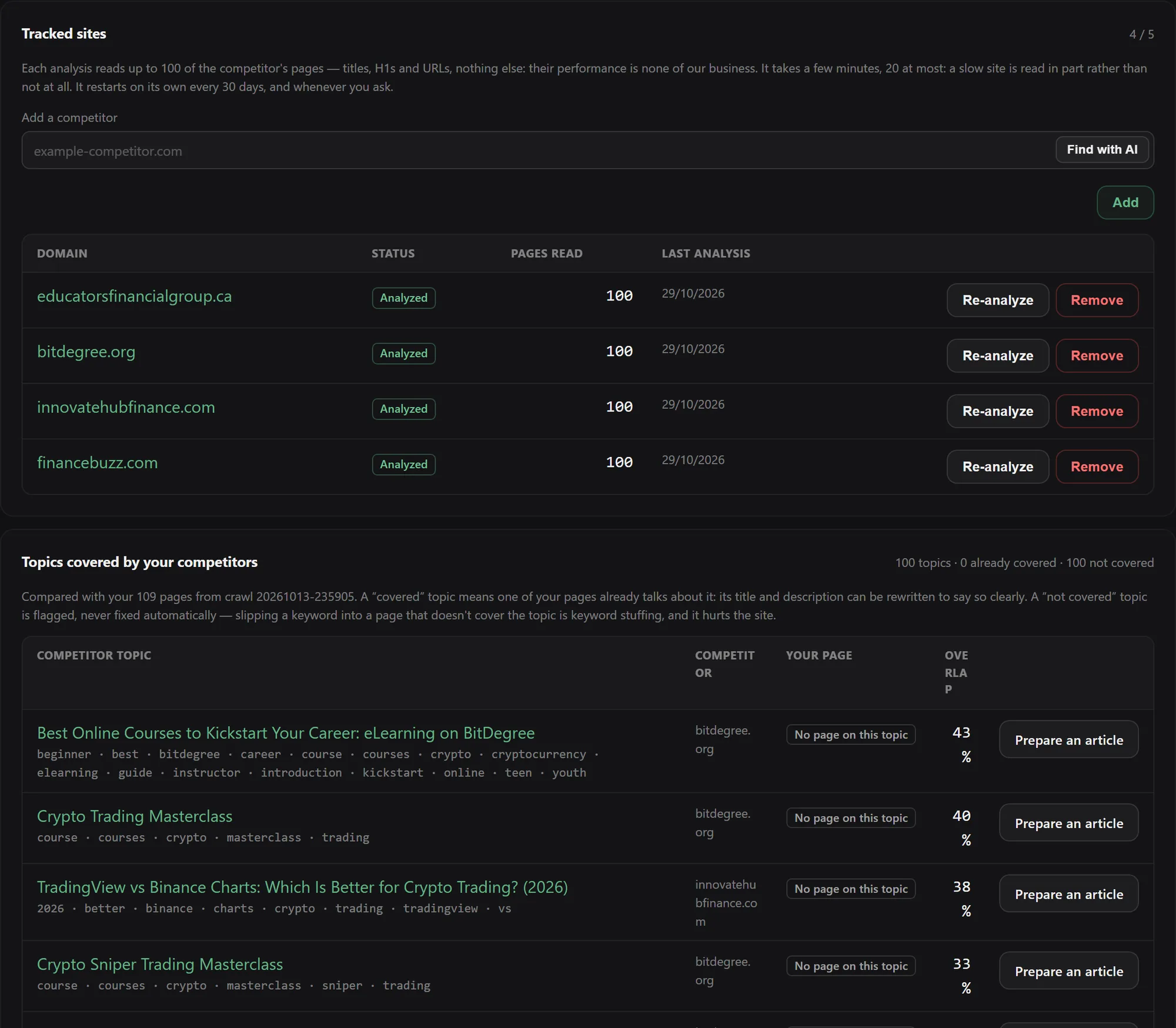
What you compare are topics — extracted from the URL, the title and the headings of each
page, on both sides. You then get two families of results, and you don't use them the same way.
Topics covered on both sides
You have a page, they have one. This is where the work pays off the most, and yet it's the half people look at least.
Your page already exists, it's indexed, it has history and links. Strengthening it costs infinitely less than creating a new one.
Cross-reference with Search Console: if that page sits in position 12 for the topic's query, you have both the what and the why.
Uncovered topics
A theme they cover and that nothing on your site addresses.
It's the exciting find, and it's also the one you need to read with the most caution.
A gap isn't always a weakness
Before you open a new doc, run each missing topic through three questions:
1. Does this topic bring customers to me? A competitor may publish on it because it's their business and not yours. A software company that writes about tax law doesn't need to be imitated by a tradesperson.
2. Do I have something to say about it? A page written without expertise shows, doesn't rank, and drags down the rest of the site. The gap is sometimes a good decision, whether you made it on purpose or by default.
3. Can I do better than what already exists? If the top ten results answer the question well, an eleventh average page won't help. Look for the missing angle — often yours: your data, your case studies, your industry.
Three “no” answers out of three: move on. It's the most frequent outcome, and the hardest to accept.
What this analysis can't tell you
Let's be clear about the limits, because many tools cross them without saying so:
- A competitor's traffic can't be known from the outside. Every estimate displayed as fact is a model.
- The fact that they publish doesn't prove it works. You're observing an intent, not a result.
- A bigger site isn't a better site. Plenty of sites publish a lot and rank poorly.
What you get that's reliable: a map of what they decided to cover. That's already a lot, because that decision cost them money and reflects a hypothesis about the market.
Putting it to use
The useful output of this analysis isn't a list of fifty topics. It's:
- Three to five existing pages to strengthen, chosen because they already rank between positions 8 and 20 on a topic your competitors cover better.
- One or two truly missing topics that pass the three questions.
- An explicit list of what you've decided not to cover, with the reason.
That third list is the one that will save you the most time next year, when someone raises the question again.
How often to repeat it
Once a quarter is plenty. A competitor doesn't redesign its site every month, and running the analysis too often pushes you to react to noise.
The right off-calendar trigger: when you see impressions drop on a group of queries. That's when it's worth looking at what changed on their side.
Frequently asked questions
Should you write about every missing topic?
Definitely not. A competitor may publish on a topic because it's their business and not yours, or because they're getting it wrong. A gap isn't a weakness until you've answered the question “does this topic bring customers to me?”
How many competitors should you analyze?
Three to five is enough, and which ones you pick matters more than how many. Choose the sites that actually rank above you for your queries, not the ones your leadership considers business competitors.
How can you tell whether a competitor is succeeding on a topic?
You can't from the outside: none of their real traffic data is available. What you can see is that they dedicate pages to it. That's a sign of intent, not proof of results.
Put this guide into practice
Noyaru crawls up to five competitors per project, extracts their topics and compares them with yours — topics you don't cover are reported, never turned into an automatic fix.
Create a free account View the documentation