
How often should you crawl a brochure site, an online store or a blog?
The right audit cadence depends on how fast a site can break, not on its size. Benchmarks by site type, plus the triggers you can't afford to miss.
That's the wrong question. It's not the size of the site that sets the cadence, it's how fast it can break.
A 50,000-page catalog that never changes needs less monitoring than a 30-page brochure site in the middle of a redesign.
Benchmarks by site type
| Type | Cadence | What breaks, and how fast |
|---|---|---|
| Stable brochure site | Monthly | Almost nothing between two crawls. The monthly crawl is there to catch what comes from outside: dead outbound links, the SSL certificate, redirects set by the host. |
| Active blog | Every 2 weeks | Every post goes through the same template. One template change introduces the issue across the entire archive at once. |
| E-commerce | Weekly | Discontinued products that turn into 404s that are still linked, facets that generate URLs, stock changes that drop pages out of the internal linking. |
| Site being redesigned | After every release | That's where 90% of SEO regressions are born. |
| Multilingual site | Monthly, full crawl | hreflang relationships can only be verified if the crawl sees both sides at the same time. |
Triggers that override the calendar
Whatever your cadence, these five events call for an immediate crawl:
- A production release. Especially if it touches the templates, the routing or the hosting configuration.
- A change of CMS, theme or host. Staging
robots.txtfiles that make it to production are a textbook case. - A URL migration. The control crawl is part of the migration, not of the aftermath.
- A drop in impressions in Search Console. The crawl tells you whether the cause is technical.
- A batch of fixes deployed. Without a follow-up crawl, you have no proof that it worked.
The fifth is the most neglected, and it's the one that costs the most: an unverified fix is a fix you know nothing about.
What a regular cadence gives you
A single crawl gives you a snapshot. A series gives you three things no snapshot contains:
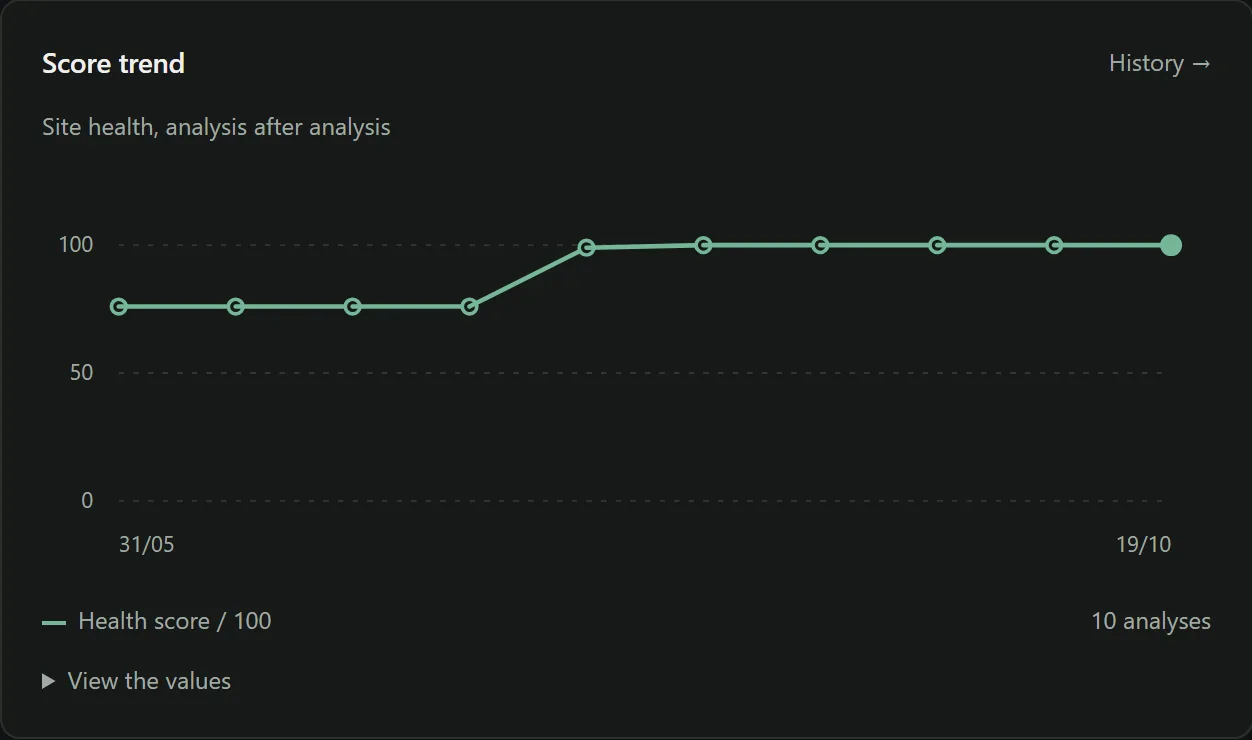
The direction of travel. Is the number of issues going down or up? On a living site, stable means you're fixing things as fast as you're breaking them.
When a problem first appeared. An issue that showed up between the crawl on the 3rd and the one on the 17th can be tied to a specific deployment. Without a history, you're digging through six months of commits.
Proof of the work done. If you bill for this audit, the comparison between two crawls is your most convincing deliverable — far more than a score.
The partial crawl trap
For the comparison to mean anything, the crawls have to be comparable. A crawl stopped halfway — page limit reached, canceled, timed out — produces changes that don't exist: 200 “missing” pages that simply weren't visited.
Two precautions:
- set the page limit above the site's actual size, with headroom for growth;
- check that the crawl finished normally before drawing any conclusion from a comparison.
A sustainable cadence beats an ideal one
A monthly crawl that actually runs every month is infinitely better than a weekly crawl abandoned after three weeks.
Start at the cadence you'll stick to, add the event-based triggers, and increase the frequency only if the crawls regularly turn something up. If three months of weekly crawls surface nothing new, you're crawling too often.
Frequently asked questions
Can crawling too often hurt my site?
A polite crawl — robots.txt respected, crawl-delay honored, concurrent requests limited — is painless. What strains a server is an aggressive crawl, not a frequent one.
Do I need to crawl the entire site every time?
To compare two crawls, yes: comparing a full crawl with a partial one produces phantom changes. A crawl limited to one section is useful for verifying a specific fix, not for tracking a trend.
Put this guide into practice
Noyaru runs the crawl, the comparison and the fix verification back to back: you don't rerun anything by hand, and a regression shows up within days of the deployment that introduced it.
Create a free account View the documentation